
Impact of Occupational Stress on the Prevalence of Anxiety Symptoms Among Workers in Guayaquil
Article Sidebar
Main Article Content
Abstract
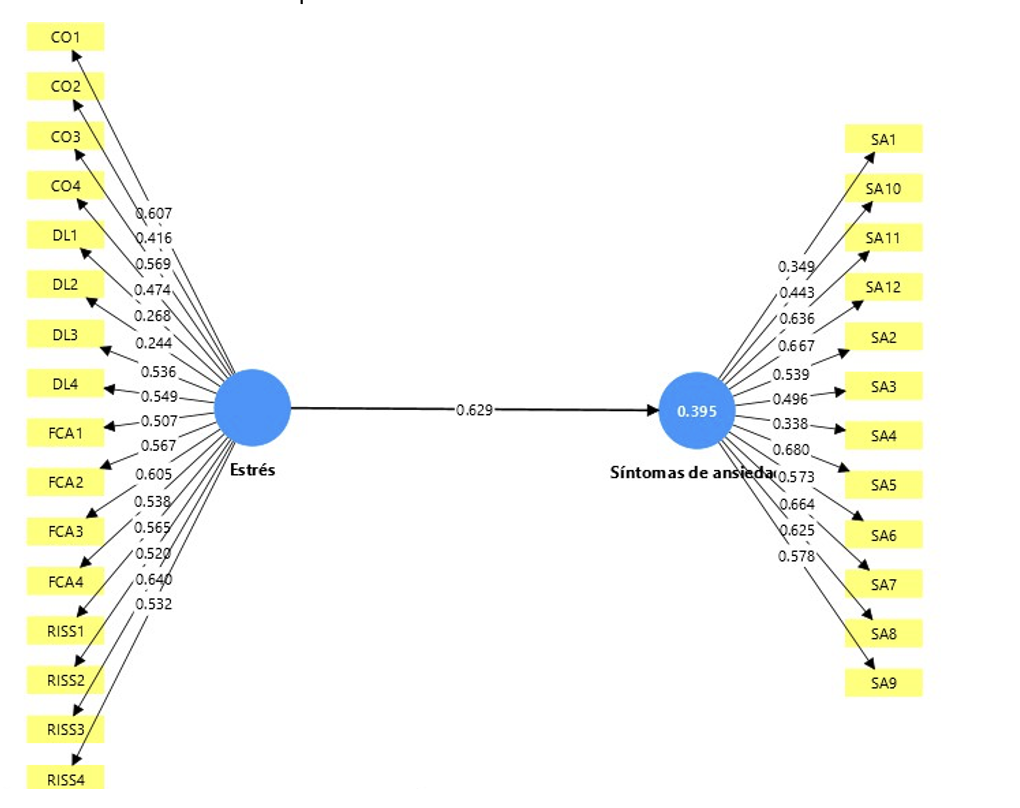
There is growing global concern regarding mental health within organizations. The present study aimed to determine the impact of occupational stress on the prevalence of anxiety symptoms among workers in the city of Guayaquil. The research was conducted using a quantitative approach with a non‑experimental, cross‑sectional, and causal design. The sample consisted of 114 participants from various employment sectors, selected through non‑probabilistic convenience sampling. Data were collected through a structured digital questionnaire based on the HSE Management Standards Indicator Tool to assess levels of occupational stress, complemented by items designed to measure anxiety symptoms in their cognitive, physiological, and behavioral dimensions. Data analysis was performed using Structural Equation Modeling (SEM). The results showed a positive and statistically significant effect of occupational stress on anxiety symptoms (β = 0.629; p < 0.001). Additionally, the model explained 39.5% of the variance in anxiety. It is concluded that occupational stress is a relevant factor in the presence of anxiety symptoms among workers in Guayaquil, highlighting the importance of implementing organizational strategies for prevention, intervention, and the promotion of mental health.
Article Details
Section

This work is licensed under a Creative Commons Attribution-NonCommercial-ShareAlike 4.0 International License.
La revista brinda acceso abierto inmediato a todo su contenido sobre el principio de que hacer que la investigación esté disponible de forma gratuita para el público para apoyar un mayor intercambio global del conocimiento.
De esta manera, el lector/a puede acceder a todos los contenidos de la revista desde el momento de la publicación sin coste ni obligación de suscripción.
La revista ienen licencia bajo el acuerdo de licencia internacional Attribution-NonCommercial-ShareAlike 4.0 International (CC BY-NC-SA 4.0). Los/as autores/as retienen los derechos de autor y se permite a terceros copiar, distribuir y hacer uso de los trabajos siempre que cumplan con los términos y condiciones establecidos por dicha licencia
- citar la autoría y la fuente original de su publicación (revista, editorial y URL de la obra).
- No se usen para fines comerciales.
- Si remezcla, transforma o crea a partir del material, deberá difundir sus contribuciones bajo la misma licencia que el original.
Puede encontrar más información al respecto en https://creativecommons.org/licenses/by-nc-sa/4.0/deed.es.
La Revista declina cualquier responsabilidad sobre posibles conflictos derivados de la autoría de los trabajos que se publican.
How to Cite
References
American Psychological Association. (2025, January 21). Salud mental/corporal: Estrés en el trabajo. https://www.apa.org/topics/healthy-workplaces/estres-trabajo
Apa, E., Nocini, R., Ciorba, A., Sacchetto, L., Gherpelli, C., Monzani, D., & Palma, S. (2024). Psychological distress and social adjustment of a working adult population with singlesided deafness. Audiology Research, 14(G), U1–103. https://doi.org/10.33U0/audiolres140G00U1
Benesch, S., & Prior, M. T. (2023). Rescuing “emotion labor” from (and for) language teacher emotion research. System, 113, Article 102UU5. https://doi.org/10.101G/j.system.2023.102UU5
Brenner-Fliesser, M., Houtenbos, S., Ewerton, M., Bontrup, C., & Visscher, R. (2024). The association of different types of stress and stress accumulation with low back pain in callcenter workers: A cross-sectional observational study. BMC Musculoskeletal Disorders, 25, Article 80087. https://doi.org/10.118G/s128U1-024-08087-5
Castro, L. S. R., Nogueira, D. S. S., Fu, C., & Casarotto, R. A. (2024). Work- related musculoskeletal complaints of physiotherapists working in intensive care units: Frequency analysis, risk factors, management and prevention strategies. Work. Advance online publication. https://doi.org/10.3233/-230422
Chen, C. C., Ping, L. Y., Lan, Y. L., & Huang, C. Y. (2025). The impact of night shifts on the physical and mental health of psychiatric medical staff: The influence of occupational burnout. BMC Psychiatry. Advance online publication. https://doi.org/10.118G/s12888025-0G701-x
Formuli, E., Gohar, B., & Nowrouzi-Kia, B. (2024). Occupational hazards and populationbased prevention strategies for pharmacy workers in Canada. Discover Public Health, 21, Article 24U. https://doi.org/10.118G/s12U82-024-0024U-z
Frieder, R. E. (2024). Operating under stress: An experiential exercise to illustrate the sources and consequences of work stress. Management Teaching Review. https://doi.org/10.1177/237U2U8123121G454
Gehanno, J. F., Leroyer, A., Couvreur, M., Volkoff, S., & Rollin, L. (2025). Changes in working and health conditions in different sectors between 2010 and 201U in a representative sample of French workers. PLoS ONE. https://doi.org/10.1371/journal.pone.0324244
George, M. G., & Collard, J. J. (2024). The influence of core self-evaluation, mindfulness, and https://doi.org/10.1007/s10U42-023-0053G-U
Germinario, G., Amin, V., Flores, C. A., & Flores-Lagunes, A. (2022). What can we learn about the effect of mental health on labor market outcomes under weak assumptions? Evidence from the NLSY7U. Labour Economics. https://doi.org/10.101G/j.labeco.2022.102258
Gonçalves, F., Gaudencio, M., Castelo Branco, M., & Viana, J. (2024). Burnout and attachment in oncology and palliative care healthcare professionals. BMJ Supportive & Palliative Care. https://doi.org/10.113G/spcare-2023-004GU4
Habtu, Y., Kumie, A., Selamu, M., Harada, H., & Girma, E. (2025). Exploring the links between work- related psychosocial factors and occupational stress, occupational depression, and job anxiety among health workers in central and Southern Ethiopia: Structural equation modelling. BMC Psychology. https://doi.org/10.118G/s4035U-02503127-8
Hollerbach, B. S., Jitnarin, N., Koeppel, M. D. H., Valenti, M., Beitel, S., Goodrich, J. M., Burgess, J. L., & Jahnke, S. A. (2024). Examination of stress among recruit and incumbent women firefighters. Safety and Health at Work. https://doi.org/10.101G/j.shaw.2024.10.003
Jeong, S., & Lee, B.-H. (2024). The moderating effect of work-related musculoskeletal disorders in relation to occupational stress and health-related quality of life of construction workers: A cross- sectional research. BMC Musculoskeletal Disorders. https://doi.org/10.118G/s128U1-024-0721G-4
Kavaliauskas, P., et al. (2024). Work-related stressors and psychological distress predict career change ideation among Lithuanian healthcare workers. International Journal of Occupational Medicine and Environmental Health. Advance online publication. https://pubmed.ncbi.nlm.nih.gov/38975635/
Kavaliauskas, P., Nomeikaitė, A., Geleželytė, O., Kazlauskas, E., & Smailytė, G. (2024). Work-related stressors and psychological distress predict career change ideation among Lithuanian healthcare workers. International Journal of Occupational Medicine and Environmental Health, 37(3), 287–299. https://doi.org/10.13075/ijomeh.1896.02350
King, B., Koenig, J., & Berg, L. (2024). Popular musician occupational stress and psychological ill health: An exploratory factor analysis. Medical Problems of Performing Artists. https://doi.org/10.210U1/mppa.2024.2010
Laferton, J. A. C., Schiller, S., Conrad, D., Fischer, D., & Zimmermann-Viehoff, F. (2024). Stress beliefs moderate the impact of COVID-1U related work stress on depressive, anxiety and distress symptoms in health care workers. Stress and Health. https://doi.org/10.1002/smi.3410
Liu, T. Y., Ko, W. T., Pramkuti, I., Griffiths, M. D., & Pakpour, A. H. (2024). Emotion regulation in the associations of inattention/hyperactivity with distress. American Journal of Health Behavior, 48(G), 1G. https://doi.org/10.5UU3/AJHB.48.G.1G
Mackoff, J., Lennox, K., & Torchalla, I. (2025). Collaborative, trauma-focused occupational therapy and psychotherapy for work-related PTSD: Two case studies. Clinical Case Studies. https://doi.org/10.1177/1534G501251324531
Marcatto, F., Ferrante, D., Di Blas, L., & Filon, F. L. (2024). Adapting the HSE-MS Indicator Tool for academia: A psychometric evaluation of the Academic Teacher Stress Indicator Tool for Italian university teachers. Medicina del Lavoro, 115(G). https://doi.org/10.2374U/mdl.v115iG.1G2U4
Marín-Berges, M., Villa-Berges, E., Lizana, P. A., Gómez-Bruton, A., & Iguacel, I. (2025). Depression, anxiety and stress in taxi drivers: A systematic review of the literature. International Archives of Occupational and Environmental Health. https://doi.org/10.1007/s00420-024-02117-4
Marti, A. R., Degerud, E., & Sterud, T. (2022). Onset of work-life conflict increases risk of subsequent psychological distress in the Norwegian working population. International Journal of Environmental Research and Public Health, 1U(20), 132U2. https://doi.org/10.33U0/ijerph1U20132U2
Máté, M., Várnai, C. H., & Ózsvári, L. (2025). A cross-national study on mental health, psychological distress and suicidal ideation among veterinarians in multiple European countries. Frontiers in Veterinary Science. https://doi.org/10.338U/fvets.2025.1G3413U
Michot, A. P., Evans, T. L., Vasudevan, M. M., Bradford, A., & Hundt, N. E. (2024). The case for screening for diabetes distress, depression, and anxiety. Journal of Health Psychology. https://doi.org/10.1177/135U1053241241841
Miller, N. E., Lally, P., Conway, R., Steptoe, A., & Frank, P. (2024). Psychological distress and health behaviours in people living with and beyond cancer: A cross- sectional study. Scientific Reports. https://doi.org/10.1038/s415U8-024-GG2GU-G
Onesti, G., Bellante, F., Lionetti, F., Fasolo, M., & Palumbo, R. (2024). The interplay among environmental sensitivity, job stressors, and leadership styles on employee well-being. Scientific Reports. https://doi.org/10.1038/s415U8-024-785G2-5
Pitron, V., Lemogne, C., Clayton, S., Léger, D., & Van den Bergh, O. (2024). Climate change anxiety and its association with somatic distress and idiopathic environmental intolerances: A cross-sectional study. Journal of Psychosomatic Research. https://doi.org/10.101G/j. jpsychores.2024.111U37
Qian, J., Vujovic, N., Nguyen, H., Rahman, N., Heng, S. W., Amira, S., Scheer, F. A. J. L., & Chellappa,S. L. (2022). Daytime eating prevents mood vulnerability in night work. Proceedings of the National Academy of Sciences of the United States of America. https://doi.org/10.1073/pnas.220G34811U
Rana, M., Bock, L., Riedel, E., Moellmann, H. L., Schorn, L., & Rana, M. (2022). The effectiveness of a four-week online mindfulness training course on individual mindfulness skills and personal perception of stress in company employees working from home. International Journal of Environmental Research and Public Health, 1U(24), 1G422. https://doi.org/10.33U0/ijerph1U241G422
Raves, D. M., Herrera, W. D., Darnell, M. E., Rice, T., Friedman, C., Moratti, S. C., Sims, S. T., Sihanath, W. B., Ehrhardt, S. N., & Phillips, A. (2025). A survey assessing the impact of symptoms related to the menstrual cycle and perceptions of workplace productivity: Considerations for employer-sponsored menstrual health programs. BMC Women’s Health. https://doi.org/10.118G/s12U05-025-03833-w
Sani, M. M., Jafaru, Y., Ashipala, D. O., & Sahabi, A. K. (2024). Influence of work- related stress on patient safety culture among nurses in a tertiary hospital: A cross- sectional study. BMC Nursing. https://doi.org/10.118G/s12U12-023-01GU5-x
Shmul, C. S., Berzon, B., & Adini, B. (2024). Navigating crisis: Exploring the links between threat perceptions, well-being, individual and workplace resilience among general hospital staff. Israel Journal of Health Policy Research. https://doi.org/10.118G/s13584-024-00G5G-2
Simonovich, S. D., Bush, N. M., Wiesemann, L. M., & Pineros-Leano, M. (2023). Qualitative study of the experience of caring for women during labor and birth during the first wave of the COVID-1U pandemic. Journal of Obstetric, Gynecologic & Neonatal Nursing. https://doi.org/10.101G/j.jogn.2022.12.00G
Spitzer, R. L., Kroenke, K., Williams, J. B. W., & Löwe, B. (200G). A brief measure for assessing generalized anxiety disorder: The GAD-7. Archives of Internal Medicine, 1GG(10), 10U2–10U7. https://doi.org/10.1001/archinte.1GG.10.10U2
Tamayo Contreras, P., & Padilla Contreras, M. I. (2019). Construcción de una escala para conocer la intención de abandono por efectos del estrés laboral. Entretextos, 11(32). https://doi.org/10.59057/iberoleon.20075316.201932124
Torales, J., Torres-Romero, A., Barrios, I., O’Higgins, M., Caycho-Rodríguez, T., CastaldelliMaia, J. M., & Ventriglio, A. (2025). Mental health, emotional regulation, and psychosocial work factors among scientific researchers: A cross-sectional study from Paraguay. Brain Sciences, 15(1), G5. https://doi.org/10.33U0/brainsci150100G5
Trifunović, N., Erkočević, H., Hasanović, E., Jatić, H., & Džebo, S. (2024). Workplace factors contributing to professional stress in family medicine. Acta Medica Academica. https://doi.org/10.5G44/ama200G-124.4G4
Wojczyk, S., Dąbek, J., Sierka, O., & Gąsior, T. (2024). The resilience of Polish doctors and their behavioral patterns in coping with work-related stress. Journal of Clinical Medicine. https://doi.org/10.33U0/jcm1324753U
Yang, C., Wu, D., Yang, H., Yin, H., & Wang, S. (2025). Psychological distress and turnover intention among Chinese nurses: A moderated mediation model of job satisfaction and social support. BMC Nursing. https://doi.org/10.118G/s4035U-025-03127-8
Yüce, H., Gökmen, G. Y., Akçay, B., & Keçelioğlu, Ş. (2024). The effect of basic body awareness therapy on awareness, stress and anxiety in pregnant women. Advances in Integrative Medicine. https://doi.org/10.101G/j.aimed.2024.08.012